


Advantages
1. On-site generation, safe storage and transportation Sodium hypochlorite is produced on demand at the user site by electrolysis of dilute brine. There is no need for bulk transportation and storage of high-concentration commercial sodium hypochlorite or dangerous chlorine gas, greatly reducing risks of leakage, decomposition and chemical accidents.
2. Stable available chlorine concentration & low impurity The ion-exchange membrane separates the anode chamber and cathode chamber effectively. It avoids the back-mixing of electrolytic products, limits the generation of by-products such as chlorate, and produces hypochlorite solution with stable and controllable available chlorine content.
3. Simple raw material supply Only high purity salt (sodium chloride) and electricity can be used as feedstock; no complicated chemical reagents are required for the main reaction.
4. High automation and easy operation The system is equipped with automatic brine feeding, electrolysis current control, liquid level monitoring and interlock protection. It can run unattended continuously, with automatic shutdown triggered by abnormal conditions.
5. Wide application range The generated sodium hypochlorite solution is suitable for disinfection of drinking water, sewage, circulating cooling water, seawater, aquaculture water and industrial wastewater. It can also be used for decolorization and oxidation treatment in many industries.
Disadvantages
1. Relatively high power consumption Electrolysis is an energy-intensive process. Power cost accounts for a large proportion of the operating cost. Unit power consumption is closely related to brine quality, membrane condition and operating current density.
2. Membrane aging and replacement cost The ion-exchange membrane is a core consumable. It will gradually degrade under the combined effect of chlorine, alkaline environment and impurities. Periodic membrane replacement brings spare part cost and system downtime.
3. Strict requirements for brine pretreatment Calcium, magnesium, heavy metal ions, suspended solids and organic matter in brine will cause membrane fouling, scaling and performance decline. A complete softening and filtration pretreatment section is mandatory.
4. Cathode and anode plate wear Electrode plates work in strong corrosive electrolytic environment. Coating peeling and corrosion will occur after long-time operation, which reduces electrolysis efficiency and requires regular inspection and recoating or replacement.
5. Cathode hydrogen by-product management Hydrogen gas is generated at the cathode during electrolysis. Effective gas collection, dilution and ventilation facilities must be installed to prevent hydrogen accumulation and explosion hazards.
6. Certain footprint and auxiliary system demand Besides the electrolyzer, the complete set needs brine preparation unit, dosing system, hydrogen exhaust system, storage tank, cooling and control cabinet.
In addition, Sodium hypochlorite is a compound often used as a bleaching agent. It is commonly found in household bleach and is used to whiten and disinfect clothing, remove stains, and disinfect surfaces. In addition to household uses, sodium hypochlorite is used in a variety of industrial applications, such as water treatment and the production of paper and textiles. However, it is important to use sodium hypochlorite with caution because it can be corrosive and harmful if not handled properly.
Yantai Jietong Water Treatment Technology Co., Ltd has been designing, manufacturing, installing and commissioning for various capacity sodium hypochlorite generator.
Concentration of sodium hypochlorite ranges from 5-6%, 8%, 10-15%
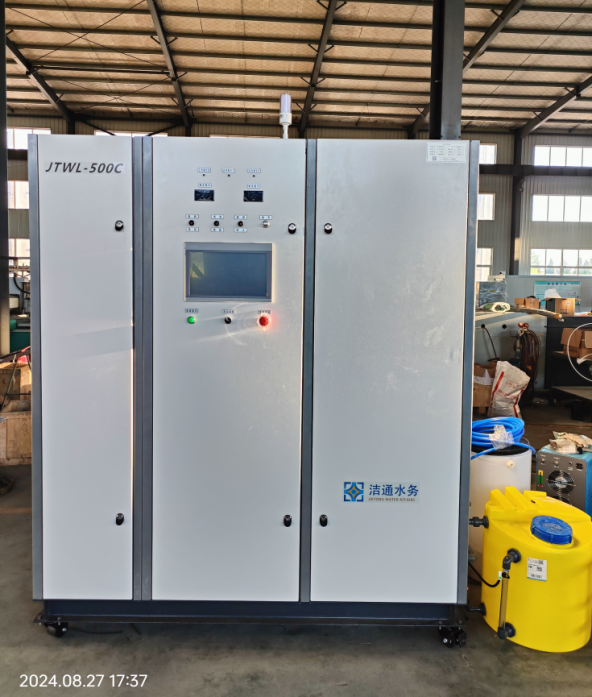
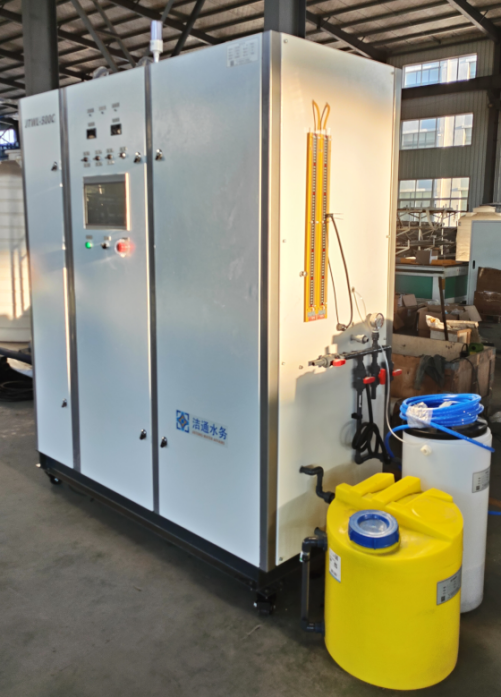
The smallest machine we can make is 500LPH sodium hypochlorite generator ready for delivery to customer, the followings are the pictures of the machine.
Post time: Nov-21-2026